
Articles & Guides
How can animals help veterans with PTSD?
TL;DR
Animals help veterans with PTSD by healing the damage brought by trauma. Research backs it. Columbia University ran the first university-led trial of equine therapy for veterans, and a 2024 clinical trial found much lower rates of PTSD diagnosis among veterans given a trained service dog. Some of the strongest stories pair wounded people with wounded animals, where the caretaking itself is the therapy for both animal and veteran.
What kinds of animal therapy help veterans?
There are many different animal therapies. The ones with evidence behind them fall into a few kinds. A trained service dog lives with a veteran full time and is taught tasks that answer that person’s symptoms. Equine programs bring a veteran and a horse together for a fixed course of sessions with a therapist present. Caretaking programs work the other way around, because there the veteran is responsible for animals that need looking after.
The Department of Veterans Affairs does not supply service dogs and never has. It refers an approved veteran to an organization accredited by Assistance Dogs International, which provides the dog and its training at no charge, and the VA then pays for that dog’s veterinary care. K9s For Warriors is one of those accredited organizations, and it matches trained dogs with veterans in group classes. Horse programs work differently (the animal is a mirror, not a companion), and caretaking programs differ again, because the veteran is the helper, not the one being helped.
What does the research show?
The evidence base is young but real, and Columbia University’s Man O’ War Project ran the first university-led trial of equine-assisted therapy for veterans with PTSD (63 veterans, eight weekly sessions of grooming, leading, and trust work, with brain scans before and after) and used it to publish a treatment manual. Studies of service-dog placement report reduced PTSD symptoms alongside standard care. Researchers are still mapping how much of the effect is the animal and how much is the structure it brings, though the direction keeps pointing the same way.
The largest test of service dogs so far was published in JAMA Network Open in June 2024. Marguerite O’Haire at the University of Arizona College of Veterinary Medicine, funded by the National Institutes of Health and working with K9s For Warriors, followed 156 serving military members and veterans who all had a PTSD diagnosis. Eighty-one of them received a trained service dog and 75 stayed on the waiting list, and everyone carried on with whatever treatment they were already having. After three months the group with dogs reported lower PTSD symptom severity than the waiting-list group. Anxiety and depression were lower too, and so was social isolation. Clinicians who did not know which group a person belonged to put the odds of that person still meeting the criteria for a PTSD diagnosis at 66 percent lower among those with a dog.
What happens at a sanctuary where the veteran is the caretaker?
Dr. Lorin Lindner started with parrots. In 2005 she opened Serenity Park on the West Los Angeles VA campus, an aviary where veterans in treatment look after parrots taken out of abusive homes. In 2009 she and Navy veteran Matt Simmons founded the Lockwood Animal Rescue Center on twenty acres at Frazier Park in California, which took in wolves and wolfdogs alongside coyotes, foxes, horses and parrots.
Stan McDonald spent ten years in the Navy Seabees. He met Lindner while he was in rehab at New Directions for Veterans, and she asked him to help build the sanctuary. He has been there since the beginning of 2009, and he says the animals are part of what has kept him sober. Veterans come out from the VA hospital each month to spend time on the land, and some of them train as veterinary assistants while they are there.
Lorin Lindner calls the model reciprocal recovery, because the animals arrived carrying their own damage. A wolfdog cannot be released into the wild, because its dog genes will not let it survive there, and it cannot settle into a house either. Nobody at the sanctuary is pushed into contact, in either direction. An animal that does not want to be approached is left alone.
Why does caring for an animal work when talk therapy is not effective?
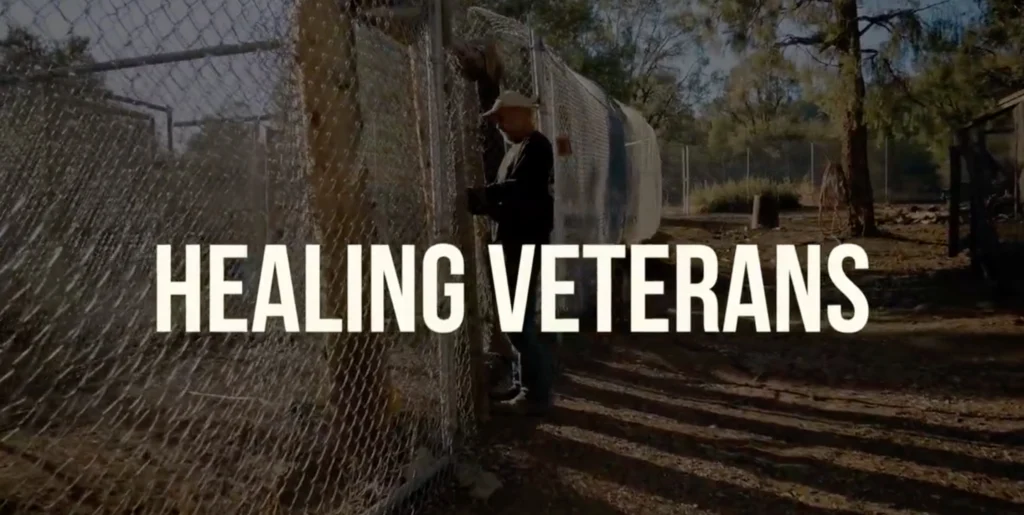
Because an animal requires consistency, not conversation, and at the Lockwood Animal Rescue Center combat veterans work as caretakers for rescued wolfdogs (animals that also cannot go home again). Our film Can Wolfdogs Help Veterans Heal? shares, in a veteran’s own words, how showing up every morning for a dependent creature helped him heal. Dr. Lorin Lindner, the psychologist who built the program, shares that idea in her book Birds of a Feather, and veterans’ path into her work often started at programs like New Directions for Veterans.
What does the VA actually pay for?
The VA does not buy anyone a dog. A veteran approved for one is referred to an organization accredited by Assistance Dogs International or the International Guide Dog Federation, and there should be no charge for the dog or its training. What the VA covers from then on is the veterinary care for that dog’s working life, including medication and emergency treatment. It also pays for replacement harnesses and leads, and for travel to the training site under its Beneficiary Travel program.
A separate program has veterans training dogs for other people. The PAWS for Veterans Therapy Act became law in August 2021 and created a five-year pilot called Puppies Assisting Wounded Servicemembers, which opened in 2024 at VA sites in Asheville, West Palm Beach, San Antonio, Palo Alto and Anchorage. A veteran with PTSD attends one 90-minute class a week for eight weeks and helps train candidate service dogs, and participants do not keep the dog they train.
Where can a veteran start?
Ask the VA about service-dog eligibility, look for accredited equine programs, or contact sanctuaries that run veteran caretaker programs directly. For a larger picture of why time with animals and nature help people recover, our Nature & Healing hub gathers the stories and research in one place, alongside the rest of our Health & Wellbeing stories. You can also find out more from conversations with Dr. Lindner on The Doggy Dan Podcast Show and Our Hen House.
Frequently Asked Questions
Does the VA provide service dogs for PTSD?
Yes. The Department of Veterans Affairs can prescribe service dogs for eligible veterans, including those with PTSD, and covers some associated costs. Nonprofits like K9s For Warriors also train and match dogs with veterans directly.
Is equine therapy proven to help veterans with PTSD?
Early evidence is promising. Columbia University's Man O' War Project ran the first university-led trial of equine-assisted therapy for veterans with PTSD (63 veterans over eight weekly sessions, with brain imaging) and produced a published treatment manual from it.
Can caring for animals be therapy in itself?
For many veterans, yes. At the Lockwood Animal Rescue Center, featured in the film "Can Wolfdogs Help Veterans Heal?", combat veterans work as caretakers for rescued wolfdogs, and the daily responsibility of keeping another creature alive becomes the structure recovery grows on.
What is the wolfdog program for veterans called?
The program at the Lockwood Animal Rescue Center in California is called Warriors and Wolves. It pairs veterans, employed as caretakers, with rescued wolfdogs. It appears in the One Good Story Project film "Can Wolfdogs Help Veterans Heal?" and the Animal Planet docu-series "Wolves and Warriors".